
ISO 9001: how a service company starts working differently in the first two months

ISO 9001 is often perceived as “just another folder with documents.” This is especially true in the service business, where everything depends on people, communication, and quick decisions. But if you look at the certificate ISO 9001 without fanaticism, it works differently. Not as bureaucracy, but as a way to bring order to daily work. Next, we will tell you honestly and without embellishment what really changes in a service company in the first 30-60 days after the start of implementation.
The first 30 days: chaos disappears, logic appears
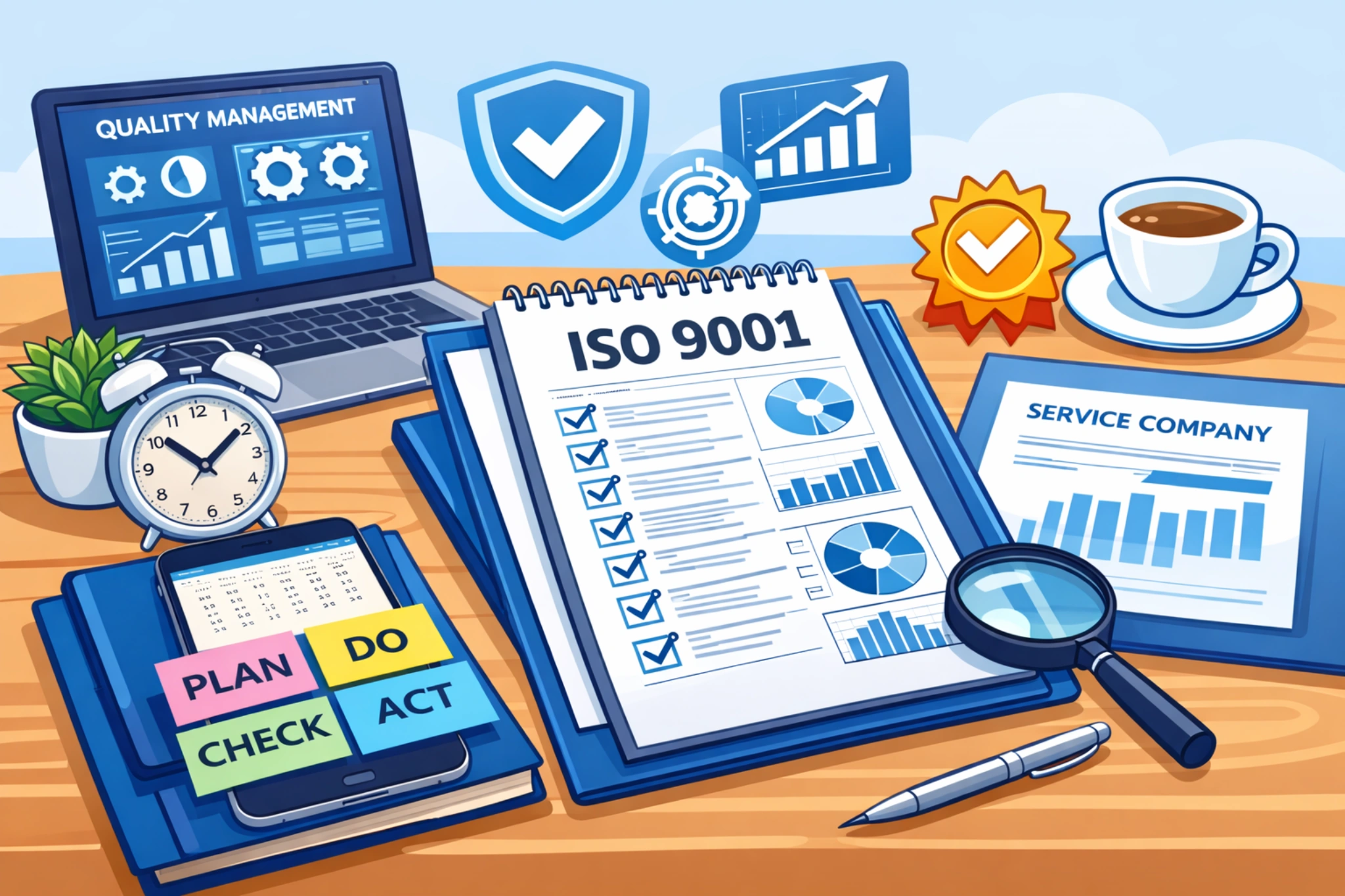 In the first 30 days after the launch of ISO 9001, there are no drastic changes, which is a normal scenario for a service company. At this stage, the standard created by the International Standards Organization 9001 launches the logic of processes and allows you to see the real picture of the work. Here is what usually happens during the first 30 days:
- Process structuring. Formulation of basic policies, procedures, and instructions.
- Distribution of responsibilities. Defining roles, responsibilities and decision-making areas.
- Communication. More transparent exchange of information between departments.
- Customer focus. Start collecting feedback and analysing needs.
- Initial monitoring. The emergence of the first metrics and identification of deviations.
At this stage, the team begins to see the “bottlenecks” that were previously masked by daily routine. That is why an ISO 9001 certification company plays a key role at the start – it helps to launch the system, rather than simply describing the processes on paper.
30-60 days: management stops putting out fires
Within 30-60 days, ISO 9001 begins to show the first tangible signs that the system is working, not just existing on paper. Management gradually emerges from the mode of constant “firefighting” and begins to manage processes rather than consequences. It is during this period that the certificate ISO 9001 ceases to look like an abstract goal and begins to be associated with real management decisions. Here’s what usually changes within 30-60 days:
- Awareness of roles. The team better understands its responsibilities in the quality system.
- Procedures in action. Updated instructions and real records appear, rather than formal files.
- Focus on the customer. Responses to requests become faster and more predictable.
- Risk analysis. The company begins to see problems before they become critical.
- First feedback. Data is collected that can already be relied upon.
At this stage, it is clear that without management involvement, there will be no rapid change. But if management is involved, these 60 days become the foundation for stable work, rather than a one-time preparation for an audit.
What does this mean for a service company in practice?
In practice, ISO 9001 for a service company means a transition to controlled and predictable work, where the quality of services does not depend on individual people. Standardised processes reduce errors, help to better understand customers and use resources more efficiently, while certificate ISO 9001 also enhances trust and opens up access to tenders and new markets. All this works as a single quality management system – from the first contact with the customer to the analysis of results and improvements. That is why ISO 9001 certification acts as a partner, helping to make the standard a practical tool for development rather than a formality.